

You rarely hear a mother say, “I made food.”
You hear, “Maine tumhare liye banaya hai.”
And somehow, those four words change everything.
Because a mother’s food has never been just about hunger. It has been about love, guilt, celebration, comfort, relationships, childhood, festivals, arguments, apologies — and sometimes, simply making sure nobody leaves the dining table hungry.
Maybe that’s why a mother’s kitchen rarely follows a recipe exactly.
It follows people.
And nowhere does that show more clearly than in the one calculation almost every mother makes without even realising she’s making it.
Ask a mother how many people are eating dinner, and she might calculate for five.
Even if there are only three people at home.
Because what if someone wants another roti? What if the child comes home hungry? What if Dad says he isn’t hungry now but wants something later? And what if a guest suddenly arrives?
There is always a what if.
So the dal is a little extra. The sabzi is a little extra. Rotis keep appearing as if the kitchen has an unlimited supply.
And if you say, “I’m full,” that’s usually not the end of the conversation.
It is the beginning of negotiation.
“Bas ek aur.”
“Thoda sa le lo.”
“Tumne kuch khaya hi nahi.”
Mothers don’t always measure love in words.
Sometimes they measure it in extra servings.
It feels so normal that we barely notice it happening. But behind that one extra roti is someone who remembers exactly how you like your food — and somewhere along the way, forgot to remember the same for herself.
She Remembers Everything — Except Herself

There is something extraordinary about the way mothers feed their families.
They remember everything.
Who likes less spice. Who doesn’t eat coriander. Who wants extra ghee. Who likes crispy rotis. Who hates onions. Who suddenly started liking paneer. Who will eat vegetables only if they’re cooked a certain way.
And somehow, this list keeps growing.
But there is one thing mothers often forget.
What they themselves like.
Somewhere along the way, their favourite food becomes less important than everyone else’s favourite food.
“Tum kya khaoge?”
“Tumhare liye kya banaun?”
And slowly, the question they rarely ask — the one that gets quieter every year — is:
“Mujhe kya khana hai?”
Maybe that’s one of the quietest forms of love. Not because mothers don’t have preferences. But because they have spent so much of their lives remembering ours that they sometimes forget their own.
It’s easy to miss this while you’re still at home, still being fed every day, still rolling your eyes at the same dal you’ve had a hundred times. The realising usually comes later — much later, and usually far away.
Food Is How She Says “I Care”
Because it was never just about what’s on the plate. It was always about what she couldn’t say out loud.
Asking “Khana kha liya?” is almost never really about food. It’s her way of asking, “Are you okay?”
You may have had a terrible day. You may not feel like talking. You may even be upset with her.
But she will still quietly put food on your plate.
No questions.
No lecture.
Just food.
That’s one of the strangest and most beautiful things about a mother’s love. Food often becomes the language she uses when emotions are too difficult to say out loud.
A bowl of hot dal can say, I’m here.
A plate of your favourite poha can say, I remembered.
And cutting you an extra piece of cake, without being asked, can say, This one is for you.
The First Thing You Miss When You Leave Home

Ask someone living in a hostel what they miss about home.
They might say their room. Their family. Their bed. Their friends.
But sooner or later, the conversation somehow reaches food.
“Yaar, ghar ki dal jaisi dal nahi milti.”
“I just want proper parathas.”
“I miss the way my mom makes aloo.”
“I haven’t eaten food like that in months.”
It sounds funny when we say it. But there is something deeper hiding behind that craving.
Because when you are far from home, you aren’t really craving a particular dish.
You are craving the feeling attached to it.
You are craving the kitchen where someone knew exactly how much salt you liked. The person who could tell from your face that you weren’t hungry. The person who would still make your favourite food even after you said, “Mujhe kuch nahi khana.”
And perhaps that’s why no restaurant can quite recreate it.
They can copy the recipe. They can’t copy the love.
The Food We Didn’t Appreciate Enough
Most of us have done this — long before we ever left home to find out how much we’d miss it.
We have sat at the dining table and said, “Again this?”
We have compared homemade food with restaurant food. We have skipped breakfast. We have left vegetables on the plate. We have said, “Mummy, today kuch achha bana do.”
And our mothers probably rolled their eyes, laughed, got irritated — or simply started thinking about what to make tomorrow.
We didn’t realise then that one day we’d be sitting somewhere far away, looking at a plate of perfectly cooked food and thinking, “I wish my mother had made this.”
That’s the strange cruelty of growing up.
We understand the value of ordinary things only after they become unavailable.
So, Next Time You Eat Her Food…
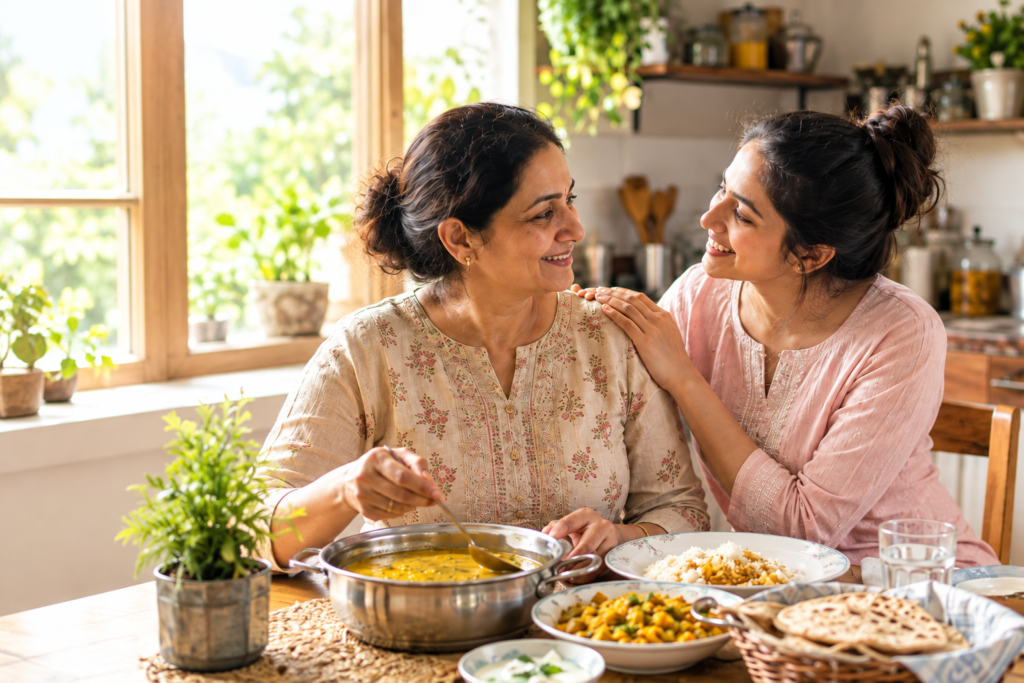
Next time you go home and your mother cooks for you, don’t just eat and leave.
Pause for a second. Look at the food. And tell her it tastes good.
Not casually. Really tell her.
Tell her the dal is perfect. Tell her the paratha tastes amazing. Tell her you missed this food.
Ask her what she likes to eat. Ask her what her favourite dish is. And maybe, for once, make that dish for her.
Because you don’t know how many times she stood in that kitchen making your favourite food while quietly forgetting her own.
You don’t know how many times she tasted the food before serving it, wondering whether you’d like it.
You don’t know how many times she heard you say, “Maa, I’m hungry,” and somehow found the energy to get back into the kitchen — even on the days her own body was tired, even on the days no one asked how she was.
And you certainly don’t know how many times, while cooking for you, she herself remembered her own mother.
Because Here’s the Part We Don’t Think About Enough
Your mother was someone’s daughter too.
There was a time when she sat at her mother’s dining table. There was a time when someone else made her favourite food. Someone else told her to eat one more roti. Someone else knew exactly how much spice she liked.
And perhaps, somewhere in a quiet corner of her heart, on some ordinary evening while she’s stirring the same dal for the hundredth time, she still misses her mother’s cooking too — a taste she can never quite recreate, no matter how many times she tries.
She just never says it out loud.
Because now, she’s the one standing in the kitchen. She’s the one who became the hands someone else’s child will one day miss.
Maybe that’s what food really carries.
Not just recipes. Not just flavours.
But generations of love. A grandmother’s hands. A mother’s kitchen. A daughter’s childhood. A son’s memories. And stories that are never written down — because nobody ever thinks they’ll need to be, until the person who knew them by heart isn’t in the kitchen anymore.
Because Food Is Never Just Food
We talk about home cooking as if it is only about spices, recipes and regional flavours.
But ask someone who has lived away from home for years what they miss.
They may not describe the perfect recipe.
They’ll describe a kitchen. A smell. A steel plate. A voice calling from another room. A mother saying, “Khana laga diya hai.”
And suddenly, you’re not an adult living thousands of kilometres away.
For a few seconds, you’re a child again.
Home. Safe. Loved.
So the next time your mother puts food in front of you, don’t take it for granted.
Eat slowly. Compliment her. Ask her what she wants.
And if she says, “Mujhe kuch nahi chahiye,” ask her again. Because maybe she has spent so many years remembering what everyone else likes that she has quietly forgotten how to answer that question for herself.
And maybe the greatest way to thank a mother for all the meals she has made for you… is to finally make one for her.
Because one day — and nobody ever tells you which day it will be — you will sit at a table somewhere, in front of food that is technically perfect, made by someone who followed her exact recipe, measured to the last spoon of ghee.
And it still won’t taste the same.
Because it was never really about the taste.
It was about the hands that made it, thinking only of you, while quietly forgetting themselves.
So call her today. Not tomorrow. Today.
Ask her what she wants to eat.
Because sometimes, the food on our plate is just food.
But sometimes, it is someone’s entire heart — served warm, one more roti at a time, for as long as she is here to serve it.
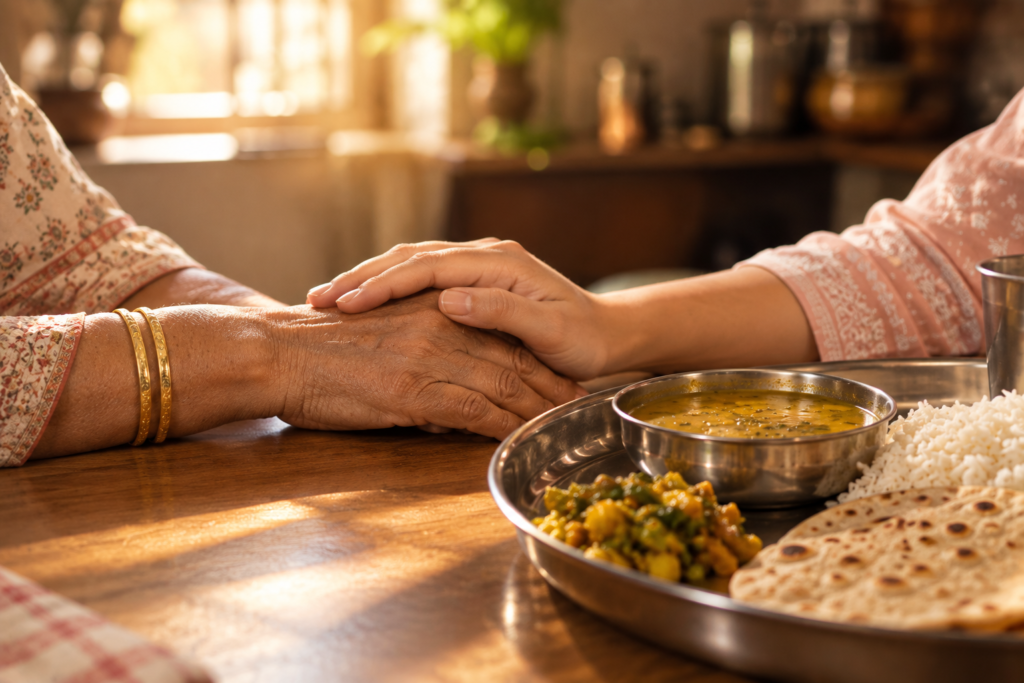
Because long after we forget the taste of anything else, we will always remember the taste of being loved.